Modern vehicles often use Variable Voltage (or “Smart”) Alternators, which adjust output based on battery load through a sensing unit, usually on the negative terminal.
Because their voltage can fluctuate too low, too high, or stop charging altogether, a Smart Battery Isolator (SBI12) is unsuitable for charging auxiliary batteries. Instead, REDARC recommends using a BCDC1225D or BCDC1240D, which ensure proper charging to 100%.
For vehicles like the Ford Ranger with Smart Charge technology, there’s no need to disable the system—simply install a compatible BCDC charger.
REDARC recommends seeking the support of a qualified auto electrician or technician.
Important
For your safety, REDARC recommends installation by a qualified auto electrician or technician. Our trusted REDNetwork is made up of professional auto electrical businesses certified by REDARC to install the complete of REDARC solutions. Find Your Local Installer
With the constant evolution of technology in today’s modern vehicles, the days of straight forward dual battery setups are becoming a thing of the past - Variable Voltage Alternators are now becoming standard issue in most modern vehicles.
The type of equipment you may need to correctly charge and maintain your auxiliary batteries depends on whether your vehicle has this technology or not. Variable Voltage Alternators are also commonly known as ‘Smart Alternators’ or ‘Computer Controlled Alternators’.
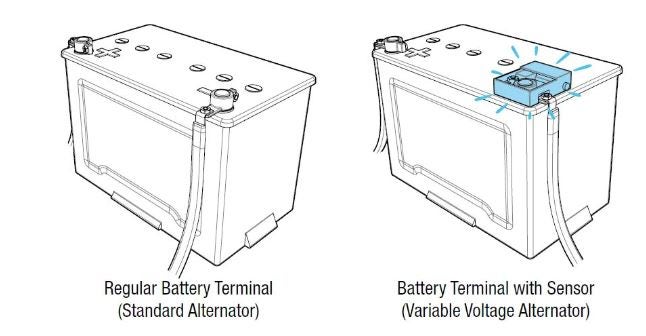
The natural question to ask is, how do I know whether my vehicle has a Variable Voltage Alternator? Variable Voltage Alternators require some sort of battery sensing technology to determine load coming from the battery and this is done by a battery sensor which is found on one of the battery terminals (usually the battery negative). Please see pictures below for examples.
Test method
Variable Voltage Alternators require some sort of battery sensing technology to determine load coming from the battery. This is done via a battery sensor, which can be found on one of the battery terminals (usually the battery negative). Please see pictures below for examples. If your alternator looks like the one on the right, you’ve got a smart alternator.
FAQs
What's the difference between a smart alternator and an alternator?
Fixed Voltage Alternators have a constant output voltage and are becoming less common in newer vehicles. They are designed to provide enough voltage to charge the start battery and also the secondary battery (leisure or auxiliary battery) to a usable level for non-essential electrical systems.
Smart Alternators, on the other hand, allow the vehicle to control the alternator's output voltage based on various vehicle operating conditions. The primary goal of this more modern system is to reduce electrical load and, consequently, the mechanical load on the engine. By dynamically adjusting the output voltage, the smart alternator can optimise fuel consumption and improve efficiency.
Can you turn a smart alternator off?
It’s possible to remove the smart charge capability, but retain the self-excite functionality. To do this, you would need to disconnect the wires that run to the PCM. However, we don’t recommend doing this, as the smart alternator is an advantage in all normal driving situations, and your battery may never achieve full charge.
My vehicle has a Variable Voltage Alternator, can I use a SBI12 (Smart Start Battery Isolator) to charge my auxiliary battery?
No, because of the way Variable Voltage Alternators work, there are several situations in which the output voltage is either too low, too high or not charging at all (hence ‘variable voltage’) therefore it's not possible to charge your auxiliary battery correctly and to 100% state of charge.
The BCDC1225D or BCDC1240D should be used instead of the SBI12 to compensate for these situations and to charge and maintain your auxiliary batteries to 100%.
I have a Ford Ranger with ‘Smart Charge’ technology, do I need to have this software disabled by the manufacturer, so I can setup a dual battery system?
No, this is not required; All you need to install is a BCDC1225D or BCDC1240D to charge your auxiliary batteries effectively.