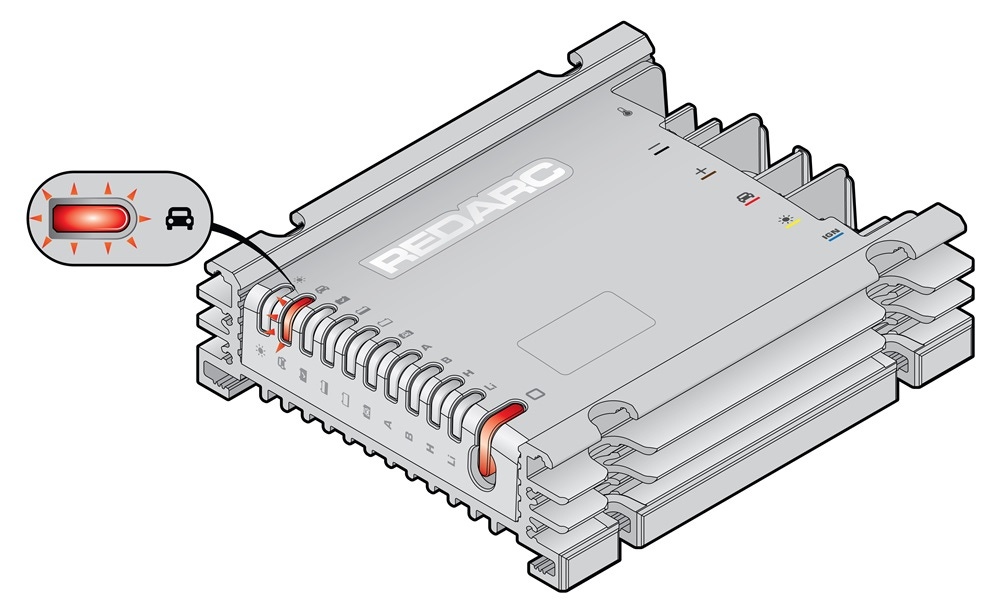
The BCDC Alpha Battery Chargers may display a flashing Vehicle status LED to indicate an input voltage fault.
This begins as a soft fault (Vehicle LED flashing with the control button LED off), where the charger will continue to operate, but if the input voltage rises further, it becomes a hard fault (Vehicle LED flashing with the control button LED on), and charging will stop.
Common causes include a faulty alternator in 24V applications or mistakenly connecting a solar panel or array to the vehicle input circuit. If voltages above 32V are detected, the vehicle should be turned off immediately and the source of the high voltage traced and corrected.
Prolonged exposure to excessive input voltage can shorten product life or cause irreparable damage. REDARC recommends seeking the support of a qualified auto electrician or technician.
Important
In this article we explain the need for testing to determine the cause of the issue. Testing may involve changes to the installation or wiring. For your safety and accuracy, REDARC recommends engaging a REDNetwork member or a suitably qualified auto electrician - Find Your Local Installer
This information is applicable to the following BCDC Alpha chargers:
- BCDC Alpha 25A DC Battery Charger (BCDC12025B)
- BCDC Alpha 50A DC Battery Charger (BCDC12050B)
- BCDC Alpha50 R DC Battery Charger (BCDC12050R)
What does this fault look like?
The BCDC Alpha Vehicle status LED will flash.
It can present as a soft fault initially and therefore the control button LED will be off. If the condition worsens, it will become a hard fault and the control button will turn on while the Vehicle status LED flashes.
What does the flashing vehicle LED mean?
This fault indicates that the BCDC Alpha has detected that the charger unit is exposed to vehicle input voltage levels outside the specification of the charger (greater than 32V).
Will the BCDC Alpha still charge my battery in this condition?
If the control status LED is off (soft fault), the BCDC Alpha will continue to charge the auxiliary battery. If the excessive voltage on the vehicle input to the BCDC Alpha increases, the control status LED will illuminate (hard fault) and the BCDC Alpha will cease charging.
What is the BCDC Alpha vehicle input voltage range?
The BCDC Alpha range has a vehicle input voltage range 9-32V.
What can cause this fault?
Caused by connecting an input source of greater than 32V on the vehicle input circuit of the BCDC Alpha.
How to determine the cause of the flashing vehicle LED?
Below is a list of the common causes and repairs.
EXCESSIVE VEHICLE INPUT VOLTAGE
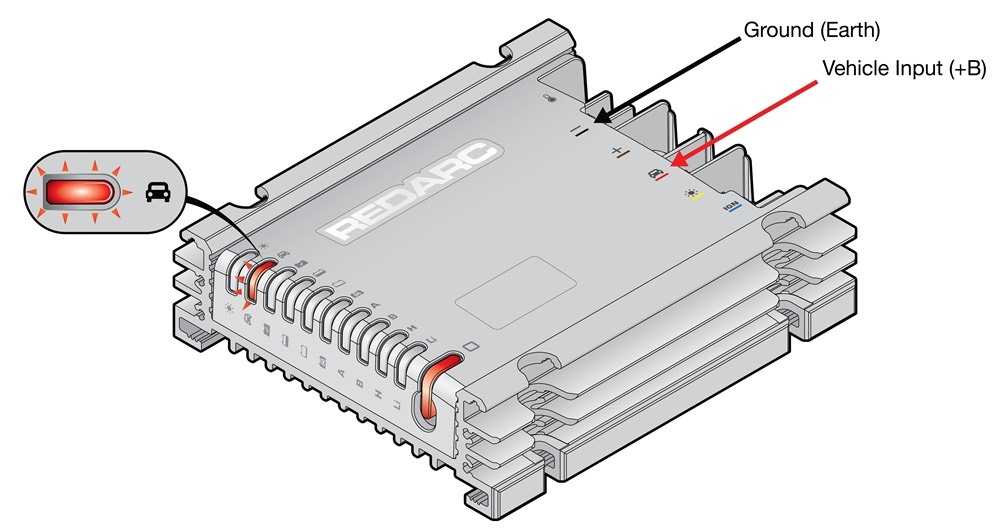
- By using a multimeter, review the input voltage and measure the voltage between the vehicle input and ground (see image below).
- Compare this to the voltage measured at the vehicle’s start battery.
- If the voltage is higher than 32V, turn off the vehicle immediately.
- Trace the cause of the high voltage.
- Once the high voltage is addressed, re-check operation.
Note: This could be caused by a faulty alternator on a 24V application or from mistakenly connecting a solar panel/array to the vehicle input circuit of the BCDC Alpha.
What happens if I'm connected to an input higher than 32V?
Exposing the BCDC Alpha to voltages outside the specifications of the unit on the vehicle input circuit can result in accelerated product life and worst-case scenario, it could result in irreparable internal damage to the BCDC Alpha.